SERIOUS MINE ACCIDENT:--- By an accident which occurred on Saturday at the Wheal Mary Ann Mine, near Liskeard, ten persons had a very narrow escape of suffocation. The following statement by one of the sufferers:- The men in the 150 cross-cut level had bored a hole, nine feet deep, and put two cans of powder in the hole, which they shut up; after the powder was blown off Johnson Rule went in to see if the powder had knocked the hole through, and took up a pick and fancied the ground was shaken; he beat the ground a bit and the earth fell away. It is supposed the fowl air escaped; at all events he fell down senseless, John Rich then went in to see what had become of his comrade, and the air catching him, he also fell, Capt. Stevens then went in, and caught hold of the two men, one under the arms and the other by the jacket he then brought them some way out; being partly suffocated and exhausted with the exertion he also fell senseless, first, however, calling to the men for more assistance. Henry Abrahams and John Johns then went in, but the fowl air by this time had become most deadly, and they both fell almost immediately, Others followed, and, in all, ten of the party fell; but after great efforts had been used by the other men all were got out. John Rich and Henry Abrahams are still very ill from the effects of the air, and had to be drawn out by the gig. It was a long time before they could be brought to; the former lay in fits for three hours after; Rich and Abrahams being the last men drawn out. Such is the unvarnished recital of this threatening accident, and we must add that too much cannot be said in praise of the courage of Captain Stevens and the men for their efforts on this occasion.
Lloyds Weekly Newspaper: Sunday 16th September 1860
At Wheal Mary Ann Mine, near Liskeard a miner named John Husband lost his life by a piece of rock falling upon him while at work underground.
The Pall Mall Gazette: Wednesday 9th October 1872
GUILDHALL:- Charge of forging a mining share. William Daniels was brought up, charged with obtaining £50, the money of Mr. Thomas Fuller, mining share broker,48, Threadneedle- Street, by means of a forged transfer of one 512th share of the Wheal Mary Ann Mine, Menheniot, in Cornwall and also with forging the same. There were other charges of a similar nature against the prisoner, but as he had not succeeded in obtaining the money, those other cases were abandoned by the prosecutor, and the prisoner was fully committed for trial on the above charge.
The Northern Star & National Trades Journal: Saturday 18th January 1851
Mining & Smelting Magazine, January 1862
MARY ANN, WHEAL
10th December 1862.
The accounts for the three months ending September showed – Balance last audit, £1,508. 11s. 2d; ore sold, £5,178 10s. 11d = £6,687. 2s. 1d. Mine cost, merchants’ bills, and sundries, £4,601. 8s. 9d: leaving credit balance, £2,085. 13s. 4d. The profit on the three months’ working was £577. 2s. 2d. A dividend of £512 (£1 per share) was declared, and £1,573. 13s. 4d, carried to credit of next account. Captains Clymo, Hodge, Harris, and Stevens reported upon the various points of operation. The stopes and pitches are producing much the same as they have for some time past.
Observations on the lodes of Cornwall, 1877
A most interesting lodes is that worked on the two contiguous mines of Trelawney and Huel Mary Ann, the former being north of the latter. Having visited Trelawney in 1858, the facts stated below relate especially to this mine, but according to the very complete descriptions of Mr. Henwood, and the notes of Mr. H. C. Salmon, upon which I rely, a great many of the characters of this vein re-appear, it seems, in the lode at Herodsfoot, situated more to the south. The lode at Trelawney and Mary Ann has been opened upon for a total length of nearly a mile. At Trelawney the bearing is N. 5° W., and at Mary Ann, N. 3° to 8° E., coinciding accurately with the directions of the principal joints, which vary from N. 12° W. to N. 8° E.f
Two faults cut through the lodes; the bearing of the first is W. 32° to 37Q N. and the underlie southward; that of the second W. 22° to 28° N. and the underlie northward. The latter has limited the working of Mary Ann towards the south, and the explorations made in the broken and slidy ground in the neighbourhood of the fault have been unprofitable.
The mean dip of the lode is 78° to 79° towards the east, the parts having greatest underlie are inclined 70°, 68°, or occasionally only 64° from the horizontal, while those nearest the perpendicular make angles of 86°, 88°, or 90°; there are indeed some local inversions where the dip is towards the west.
The mean size of the lode is about 2 feet, and it varies in width from 6 inches to 4 feet; in some places it is composed of numerous subordinate veins.
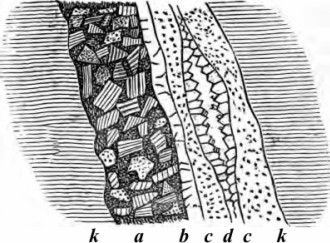
The lode is accompanied by a well developed siliceous selvage or capel, which is very remarkable on account of the appearance of the quartz and its brecciform structure. The quartz is white and porcellanous, and it encloses fragments of black killas, having sharp edges and appearing to be silicified, as shown in the figure in the note below. In the stopes at Trelawney, I have seen this breccia from 3 to 4 feet wide. Mr. Henwood says “it rarely extends more than 4 or 5 feet from the lode, and it never contains much galena; it occurs more often on the foot wall than on the hanging wall. Contrary to the common opinion as to a similar structure in a copper district, this breccia is considered as a favorable indication in the whole of this lead-bearing district.
The following figure from Dr. Le Neve Foster’s account of the lode at Huel Mary Ann, is a cross-section of the lode at a point where the brecciform capel is found on the foot wall, as shown at a; b is a band of vitreous quartz; c & c are bands of chalcedonic quartz known as “cab”; and d is a band of crystalline quartz containing many “vughs;” k & k is the killas. (See Trans. Royal Geol. Soc. Corn. Vol. IX, pp. 155.)
 |
I will add as a contrast to the preceding remarks, that the encasing rock is here harder in the immediate neighbourhood of the lode than at a distance of some fathoms, whilst nearly everywhere else when a cross-cut is driven in search of a lode its nearness is indicated by a softening of the ground. It would seem almost evident that the silicification of the rock and the formation of the quartzose breccia having from the first prepared a particularly stable cavity, the obliteration of the vein or its transformation into flucan has here been prevented; not only have the walls been consolidated, but new surfaces still more solid have been provided by the thick quartz breccia. From the variety of minerals contained in this lode, (At the outcrop in the region north of the lode there was gozzan, in the upper levels carbonate and phosphate of lead were found; lower down with the galena there was pretty much iron pyrites, with a little blende and copper-pyrites. The presence of this latter mineral appears to be a favorable indication of richness in silver. The average proportion of silver per ton of dressed mineral varied in different parts of the workings from 35 ozs. to 66 ozs, and the general mean would be close upon 50 ozs. As to the earthy gangnes the most abundant after quartz was fluor spar; barytes occurred in quantity about the 40-fathom level, and more rarely down to the 80-fathom level, while carbonate of lime especially occurred in the lower levels. These two latter substances are generally scarce in Cornwall, but they occur largely in other mining countries. In 1858, at Trelawney Mine 100 tons of mineral raised, yielded when dressed 8 to 8£ tons of merchantable ore,) it is probable that the filling was continued during many geological periods.
Fine crystallizations were also frequently met with in cavities or “vughs.” In 1858, some of the levels at Trelawney laid open magnificent vughs which continued open for a great Length at the backs of levels, rising almost vertically to a height then undetermined.
The mineral was not equally distributed throughout the lode, it was especially abundant in those parts which were most nearly vertical, and appeared concentrated towards the middle of the lode. The rich parts did not occur as well-defined columns or shoots, on the contrary they consisted of a series of little lenticular masses connected by threads of mineral. Moreover, in spite of the regions disturbed by the east and west faults, the almost contiguous workings have included nearly the whole of the lode. The workings have been carried to a depth of 256 fathoms, and the lode proved productive at Trelawney for nearly 500 fathoms in length, and at Mary Ann for about 300 fathoms in the lower levels.( The “exploitation” of this lode was very active. Trelawney began to sell ore in 1844, Mary Ann in 1846; from these dates to the latter months of 1868, or a mean period of 23½ years, the value of the mineral extracted reached the sum of £919,769. Wheal Mary Ann was stopped in 1874.
(Kenwood Address, p. 11, and Met. Dep. p. 215.)
Thus, these straight lodes having few undulations, a great angle of dip, a width subject only to gradual variations, and a disposition of metallic contents which seems more regular in cross section than longitudinally, form true types of lead bearing, cross-courses; we see clearly in what manner their general characters (allures) differ from those of the lodes of copper and lead belonging to the east and west class of Cornish lodes, and also that they deserve to attract the attention of the miner; but when we once recognise to what a concourse of favorable circumstances their origin and development is due, we need not be astonished at the relative rarity of such deposits in Cornwall.
Extracts from the book by, J.H. Murchison, Esq., F.G.S. 1854 report on:-
MARY ANN, WHEAL
In 512 Shares. £5. 5s Per Share Paid.
(On the Cost Book System.)
This mine is situate in the parish of Menheniot, near Liskeard, Cornwall. The total amount of dividends paid have been £14,720, or £28. 15s per share. The dividends paid in 1853, were £1,729, or £3. 10s per share. The net profit for the three months, ending June, 1854, was £931 12s. 8d, the ore sold during that quarter realising £6,502 8s. 1d. The costs are, however, for a time, unusually heavy, in consequence of the erection of a new 80in. cylinder steam engine, and in order to pay for the same the dividends are of course suspended, but will most likely be resumed in 1855.
The following is a copy of the agent's report of 18th October, 1854:—Pollard's shaftmen are still engaged in cutting the plat in the 120 fathom level, and hope to complete it by the end of next week. The lode in the 110, south of Pollard’s shaft is 3 feet wide, worth £20 per fathom; in the same level north, it is 3 feet wide, worth £10 per fathom. In the 100, north of the shaft, it is 3½ feet wide, worth £12 per fathom; in the same level south, it is 2½ feet wide, worth £14 per fathom; on the eastern part of this level south, it is 2 feet wide, worth £10 per fathom. In the 90 south, it is 4 feet wide, worth £18 per fathom; in the same level north, it is 3 feet wide, worth £12 per fathom. Clymo's Engine Shaft is sunk 55 fathoms under the surface. The stopes and pitches throughout the mine are producing much as usual. We sampled on Friday last, the 13th instant, two parcels of lead ore, viz., No. 1, computed 80 tons, to T. Somers, Esq., at £24. 4s. 6d per ton; and No. 2, 45 tons, to Messrs. J. & W. Pontifex, & J. Wood, at £9 per ton.
October 18th. P. Clymo, Jun.
The present price of the shares is about £37. The office is at Liskeard.
Mining Journal 3rd January 1857.
MARY ANN, WHEAL
Sold on Thursday last, 2 parcels of lead ore – 63 and 61 tons to Thomas Somers, Esq., at £25. 3s. 6d per ton; and 78 tons to Messrs. Sims, Williams, and Co., at £8. 15s per ton.
Liability Chronicle 1st April 1857.
MARY ANN, WHEAL
At the mines meeting the accounts showed a balance in favour of adventurers of £3,248; a dividend of £2 per share was declared; the net profit on the three months working was £1,923.
Liability Chronicle 1st July 1857.
MARY ANN, WHEAL
At the mines meeting the accounts showed a balance in favour of the mine of £4,148; the profit of three months working was £2,948; a dividend of £2. 5s per share was declared.
Liability Chronicle 1st October 1857.
MARY ANN, WHEAL
At the mines meeting the accounts showed a balance in favour of the company of £4,414. The profits on the three months’ working was £2,769; a dividend of £2,304 (£2. 5s. per share) was declared, and £2,002, carried to the next account.
Report on mines by C. Twite, 31st December 1863.
MARY ANN, WHEAL
This is one of the old established mines of the district.
There are principal shafts, each of which is used is an engine and drawing shaft.
1. Pollard's Shaft. This is a perpendicular shaft, and is down 205 fathoms from surface. It is 10 feet by 14. The engine part being 10x8, the whim part 10x6.
2. Clymo’s Shaft. Also a perpendicular one, about 72 fathoms from Pollard’s. It is 11 feet by 15. Engine part 11 x 8. Whim 11 x 7. It is down 205 fathoms from surface, and has communication with Pollard's.
In both shafts skips are employed and Hat hemp ropes. The ladder way in each shaft, for shaft and pitmen is put in 3 fathom lengths with a base of 4 feet.
Footway for Men. A special shaft for this purpose to the adit. A small house over it to keep rain out. It is perpendicular for 6 fathoms, with the ladder dipping 2 ½ feet per fathom, from there to adit upon course of the lode inclining 4 feet per fathom. From the adit to the 90 an old shaft (Barrett's), is kept clear as a ladder way, sunk on the course of the lode, and dipping at the rate of 4 feet per fathom. From the 90 the men go through special winze’s.
Drying and Changing House. A good sized house, 52 feet long, 18 feet wide, and 20 feet high. It has two windows and a ventilator in the roof. It is warmed by a fire and tube. From 70 to 80 men change here, and it is about 60 fathoms from the footway.
About 30 men change in the boiler house which is very roomy, and well provided with windows. The fillers, landers, and trammers change in the whim boiler house.
There is a change for pitmen, and two houses for shaft-men.
All the dressing operations are carried on under sheds, most of which arc provided with moveable hanging sides to protect the dressers against wind and rain.
One shed is completely boarded in, and provided with a fire and seats. This is for the women and girls to dine, &o. in. During the summer the kettles are boiled in the smith's shop.
Shareholders Guardian 22nd March 1865.MARY ANN, WHEAL
At the Wheal Mary Ann meeting, on Tuesday, the accounts showed a credit balance of £2,048 16s. A dividend of £512 (10s. per share) was declared, and £1,586 16s. 6d. carried forward. Captain. Peter Clymo, Hodge, Harris, and Stevens report that the stopes and < pitches are producing much the same as they have for some time past.
The Shareholders Guardian 21st March 1866MARY ANN, WHEAL
At the meeting the accounts showed a profit on the workings for October, November and December of £139 5s. 4d, leaving a credit balance of £850 3s. 9d.
The Railway Register 1846, page 42-43
MARY ANN, WHEAL
This is a fine sett, immediately adjoining Trelawney to the south. The levels of the latter mine are driven nearly home to the boundary of Mary Ann. In the latter, two shafts, have been sunk: one on the hill, and another close by the boundary of Trelawney. In this shaft the lode has been out at about 5 fathoms in depth. It is 3 feet wide, and contains beautiful stones of rich silver Lead. This is the favorite mine of the district, and it is thought will equal Trelawney. The dues here are l-12th.
Thomas Spargo 1864
MARY ANN, WHEAL
In the parish of Menheniot, is under the management of Captain P. Clymo, and is a good mine. Only one lode worked on, which runs into Trelawney Mine, and has been taken away for over 200 fathoms, yielding large returns and profits. Agents, Captains H. Hodge, J. Harris, and J. Stephens.
THE CORNISH MINING INDEX has been instigated. For example, a search for a RICHARD PRIN(N) of Menheniot provides us with quite a revealing image of his life (sources in brackets). RICHARD PRIN(N) son of RICHARD and MARTHA, born circa 1822, married ELIZABETH BARRETT born circa 1825 at Stoke Damerell on 5 April 1846 (Strays Index). On the night of 30th March 1851 Richard, his wife and one year old son HENRY are residing at Menheniot, and Richard's occupation is given as Lead miner (1851 Census). However this was not to be for long, for on 13th November 1857 Richard's hands are shattered in an explosion at Wheal Mary Ann, which ultimately drew to a close his mining career ("The Cornish Times" 22-11-1857). But Richard must have been quite some character, despite having lost both arms, in 1864 he is working as a wagon driver. Unfortunately fate was unkind yet again, for on 7th June 1864 whilst delivering coal with his son Henry in Liskeard he is fatally injured when a chimney of a house being demolished fell on him ("The Cornish Times" 11-6-1864), and was finally laid to rest at Menheniot on 17th June 1864.
In Chancery:
In the Matter of an Act of Parliament, made and passed in the 19th and 20th years of the reign of Her Majesty the Queen, intituled " An Act to facilitate Leases and Sales of Settled Estates;" and in the Matter of another Act of Parliament, made and passed in the 21st and 22nd years of the reign of Her Majesty the Queen, intituled " An Act to amend and extend the Settled Estates Act, 1856;" and in the Matter of another Act of Parliament, made and passed in the 27th and 28th years of the reign of Her Majesty the Queen, intituled " An Act to further amend the Settled Estates Act, 1856; and in the Matter of the settled estates of Aim Frost, deceased, consisting of one equal undivided third part of and in certain fields or closes of land, called High Park, Higher Gallis Park, Lower Gallis Park, and waste at the bottom of Lower Gallis Park, Gallis Park Meadow, Woodcock Park, Lower Woodcock Park, and Woodcock Park Meadow, being parts of a freehold tenement and estate called Scawen's tenement, situate in the parish of Menheniot, in the county of Cornwall (save and except the mines and minerals in and under the same); and in the Matter of one equal undivided third part of and in a cottage called Giddys Cottage, situate in Trecondale, in the said parish of Menheniot, with the garden and appurtenances thereto belonging; and in the Matter of two cottages, called Pollard's Cottages, situate in Trewint-lane, in the said parish of Menheniot, with the gardens and premises thereto attached and belonging; and in the Matter of one equal undivided third part of one equal undivided moiety or half part of and in the mines, ores, metals, and minerals in and under the 'said tenement and estate, called Scawen's Tenement, including the mine thereon called Wheal Mary Ann, all which hereditaments were appointed and devised by the will or testamentary appointment, bearing date the 3rd day of December 1852, of the said Ann Frost, deceased, the late wife of Langford Frost the elder, of Plymouth in the county of Devon, Gentleman.
London Gazette: 9th June 1865.
1st July 1853